
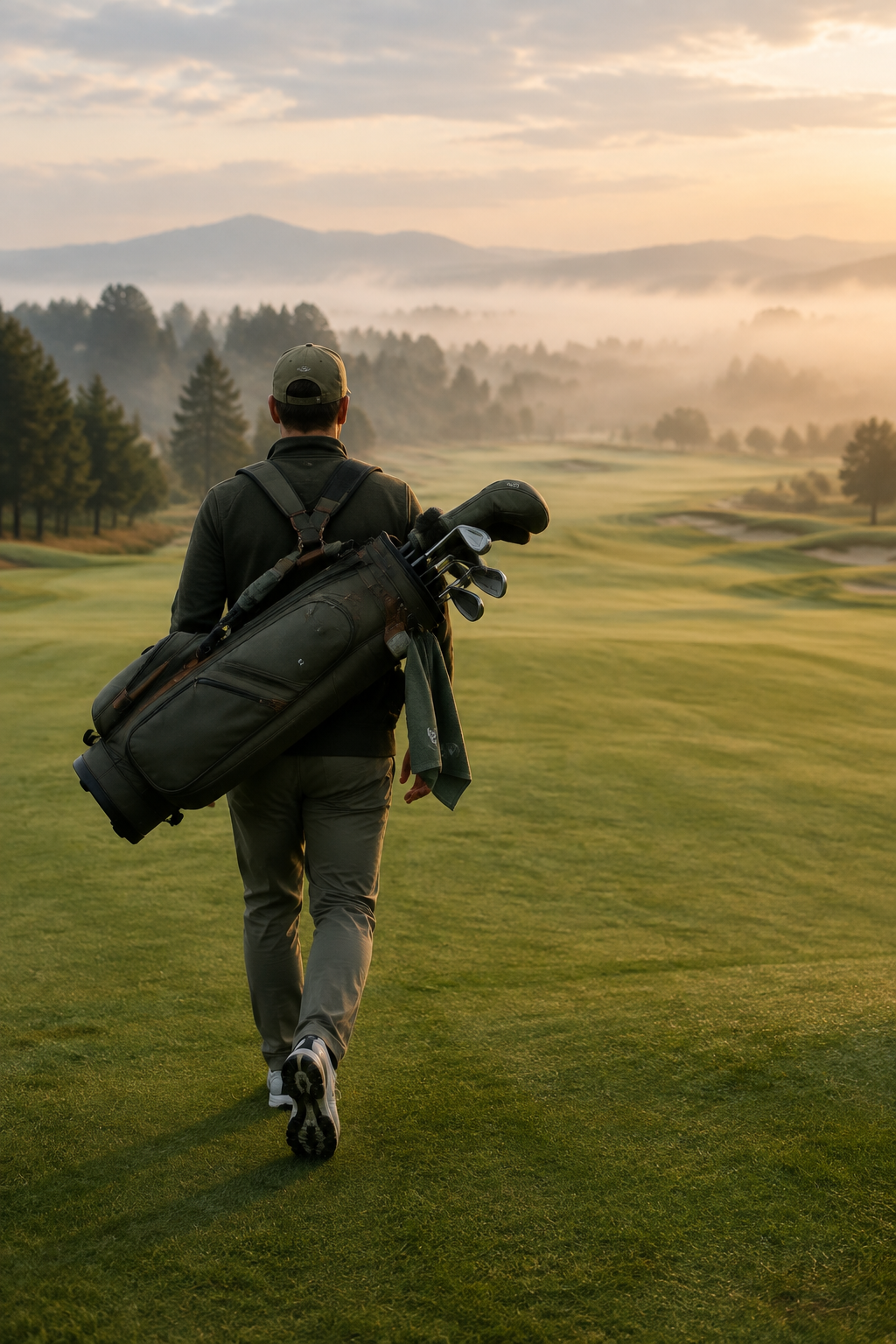
Four hours, one bag
Ask someone at their first tournament what they are bringing and they will describe a picnic. Ask the same person at their fourth and the bag has halved. Somewhere between those two days they walked eight kilometres carrying things they never used, and the lesson stuck.
This is what regular spectators actually carry, what they leave in the car, and the one test that sorts one from the other.
The test
If you have to put it down to watch a shot, and pick it up again to follow the group, it costs you more than it gives.
That single rule eliminates most of what people bring. A tournament day is not a picnic in a field. You stop for ninety seconds, watch, and move. Anything that needs unpacking, assembling or arranging will be used once, at the second hole, and carried for the remaining sixteen.
What survives
Water
More than you think in summer, and more than you think in winter too, because wind dehydrates as efficiently as heat. A bottle you can refill beats two you cannot.
A layer
The temperature between the first tee at nine and the eighteenth green at five is rarely the same, and on a coastal course it can differ by ten degrees. A thin shell that packs down to nothing earns its place. A heavy jumper does not.
Sun protection
Four hours of direct exposure with no shade on most courses. A cap does more than sunscreen and needs no reapplying.
Something to sit on
The one item that changes the day, and the one most first-timers leave behind. Eight kilometres of walking punctuated by long waits is exactly the situation a seat is for. The difficulty is that almost every seat on the market was designed for fishing, camping or a stadium, and none of those places have the constraints of a golf course.
What gets left in the car
The folding chair with arms
Too heavy by the third hole and too tall at the ropes. A spectator sitting in a camping chair has their head at roughly the same height as the people standing behind them, which is the one thing golf crowds do not tolerate. You will be asked to move, politely, and you will spend the day standing next to a chair you carried for nothing.
The large bag
Whatever its capacity, you end up carrying it on one shoulder for four hours because the other shoulder has the seat. Small and boring beats large and clever.
The camera
Most tournaments forbid photography during play, some forbid it entirely on competition days. Check the spectator guide before packing a lens you will not be allowed to raise.
The picnic
Food at a tournament is expensive and mediocre, which tempts people into bringing lunch. In practice you eat standing up in ninety seconds between two groups, and a sandwich in a pocket does the job that a cool bag was brought to do.
The shoulder test
Here is a quicker version of the rule above. Put everything you plan to bring on one shoulder and walk around the block. Not around the house: around the block, for ten minutes, without swapping sides.
Whatever makes you want to swap shoulders in ten minutes will make you miserable in four hours. Take it out and try again.
If you have to put it down to watch a shot, it is too much.
What a full day actually looks like
Nine in the morning, first tee, everything on your back and nothing in your hands. Three holes standing, because the crowd is dense and the positions are taken. From the fourth, the gallery thins and you start choosing where to be rather than where there is room.
By the turn you have sat down six or seven times for two or three minutes each. Not a rest, exactly: a way of watching a shot properly instead of shifting your weight and looking over somebody. By the fifteenth, the people who brought nothing to sit on are standing at the back with their arms folded, and the ones who brought too much are in the hospitality tent.
The spectators still at the ropes on the eighteenth green, four hours and eight kilometres later, are almost always carrying the least.